
by Soncha Iacono (2018)
Sitting on the train tumbling through the beautiful Czech countryside scattered with snow, I feel in awe of the amazing experience I have had at the Museum Loutek Plzen, (Pilsen) in March 2018 on my very first overseas trip.
It was a completely immersive experience and a total inspiration peering into the intricate world of puppetry. I spent four hours in the museum, reading, sketching, watching and photographing the brilliant worlds of puppet pioneers, from the early 19th century through to the 20th century and modern day puppet theatres. The careers of Josef Skupa, Karel Novák, Gustav Nosek and Jiří Trnka, amongst others, are tracked through time in a wonderful presentation. The LDFO– Summer Camp Puppet Theatre, Skoda Puppet Theatre, DRAK Theatre and modern day Alfa Theatre were also of note.
My trip to the Czech Republic was inspired by the search for the story of puppetry and stop motion animation, in the very heart and homes of Jiří Trnka, Jan Švankmajer and Jiří Barta. The trail began in the center of Praha, catching underground trains, riding rattling, old tramcars and walking down cobblestone streets and alleyways.
First, I found myself on the way into the Praha 7 district, looking for the Prague Puppet Museum, which sadly, I found to be closed down. In its place, a small art gallery and a friendly lady greeted me, who then sent me a thread across the city to the Karel Zeman Museum.
Arriving via the famous Charles Street Bridge with all its characteristic charm, led me straight into the quaint front entrance of the museum, nestled by a cobblestone arch. Here I found a spectacular interactive display of old school techniques in special effects and stop motion film and animation from the 1940’s to the 1980’s era, including photographs and documentary material from the life and work of the visionary filmmaker Karel Zeman.
Zeman was a true successor to pioneer special effects master Georges Méliès and became a magician of the big screen, inspiring the legendary worlds of Tim Burton and Terry Gilliam. Zeman’s films combined live action and animation in harnessing the magical worlds of fairy tales and fantasy with elaborate finesse and ingenious technique.
The museum also contains original puppets and film sets, in particular the wonderful wooden puppet ‘Mr Pan Prokouk’, a comedic puppet popular with children and the amazing hand blown glass figurines made to drawing specifications by Zeman for his animated film ‘Inspiration’, (1948). This film is an extraordinary work of art.
The brilliant production techniques presented from the wonderful film ‘Vynález Zkázy’/ ‘The Fabulous World of Jules Verne’, (1958), are also truly impressive. Set painters made special wooden rollers to paint both backdrops and costumes in black and white stripes to give the impression of Verne’s beautiful illustrated engravings. It works a treat and is truly amazing! The film circled the globe winning many awards and became one of the most significant films of the 20th Century.
“I’m on a journey to discover the beauty of the fairy tale and I want to stay on that path, trying to find better ways to capture it on film…Fairytales are the most beautiful things the world has created for the eyes of a child… … When I was a kid, we had a small toy theater and we’d put on shows… And somehow, ever since, I’ve taken puppets to my heart.” Karel Zeman.


1.‘Vynalez Zkazy/ The Fabulous world of Jules Verne’, 1958: Museum Karla Zemana – Photo S. Iacono
2. Zeman painting puppets for ‘The Treasure of Bird Island’ 1952: Museum Karla Zemana


3. ‘Inspiration’ glass figurines & film set, 1949: Museum Karla Zemana – Photo S. Iacono
4. Zeman with ‘MrPan Prokouk’ puppet, circa 1946-1959: Museum Karla Zemana


5. ‘Mr Pan Prokouk’ puppet, circa 1946-1959: Museum Karla Zemana
6.’Mr Pan Prokouk’ & Horse puppets: Museum Karla Zemana – Photo by S. Iacono
The next part of the trail sent me in search of Jan Švankmajer’s Gambra Gallery, studio and home, where I walked down cobblestone alleys near the Prague Castle into a district called Nový Svět – here cannon balls from the Prussian Wars still remain dented in the houses! As I approach, I peer up to see two amazing clay heads atop the poster bannisters of a wooden balcony. A window is slightly open and I daringly peek in, spotting a marionette puppet poking its head up out of a plastic bag! The home of Švankmajer! I felt so happy to have found his home, emotion welled up and tears even watered my eyes. I dared again and knocked on the door. No answer. Sadly, Gambra Gallery had also closed.
I am in awe of the many years Švankmajer spent alongside his wife Eva Švankmajerová, creating masterpieces in stop-motion and collage animation for the world to see and be inspired by. At age 83 years today, it is truly remarkable that he is still making films. His recent work Insects- Hmyz (2018) is a retelling of the 1922 absurdist literary adaptation ‘The Insect Play’ by Karel and Josef Čapek and is inspired by Franz Kafka’s Metamorphosis. Švankmajer’s brilliant repertoire also includes some of my favorite stop motion films Alice (1988), Faust (1994), Little Otik (2000) and Lunacy (2005).
Next, I found my way to the end of Švankmajer’s street and into an old log cabin café, ‘House at the Crayfish’, preserved as one of the first log cabins to ever be built in the area. Peering at all the interesting paraphernalia, of weathered clocks, rusty scissors, old keys and bottles, I am sure Švankmajer conjured many an inspirational sketch here, sipping coffee, mulled wine, or a traditional Czech hot orange juice called Punc near the open fireplace. This was as close as I could get to the world of Švankmajer.
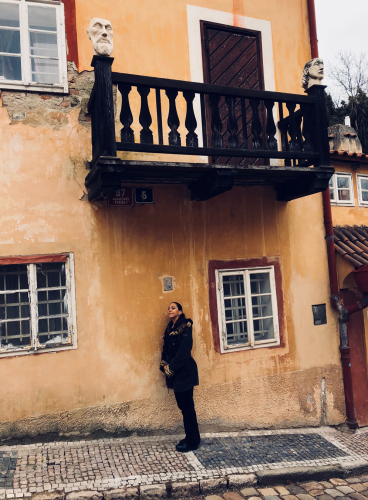

7. & 8. Svankmajer’s Gambra home studio & balcony, Novy Svet, Prague, 2018
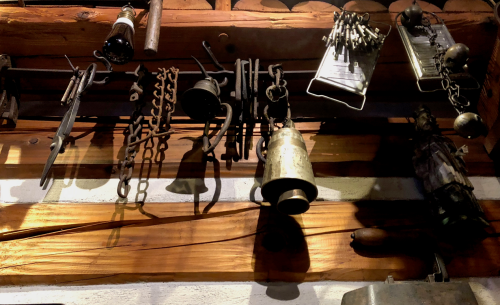
9. House at the Crayfish, Novy Svet – Photos S. Iacono
Finally, my search for Czech puppets led me to take a train ride out of Prague for two hours to the town called Pilsen. Here I find the wonderful Muzeum Loutek Plzeň. The puppet museum is a Renaissance style house and sits opposite the grand Cathedral of Bartholomew and an impressive town square filled with market stalls, spruiking hot crepes, coffee and gingerbread candy, along with the tinkering sounds of a delightful horse carousel. I am at finally at home.
Pilsen has a long history of puppetry, especially of travelling folk puppeteers, who were skilled in bringing both children and adults together. The museum opened in 2009 and holds three floors of an interactive exhibition, ranging from traditional, nomadic folk puppetry to modern day theatre productions. It displays a unique collection in conjunction with the Museum of West Bohemia in Pilsen, as the center of puppetry in the Czech Republic. It also contains a life size model of Pilsen’s oldest puppet theatre: the 19th century Škoda Theatre with its original marionettes.
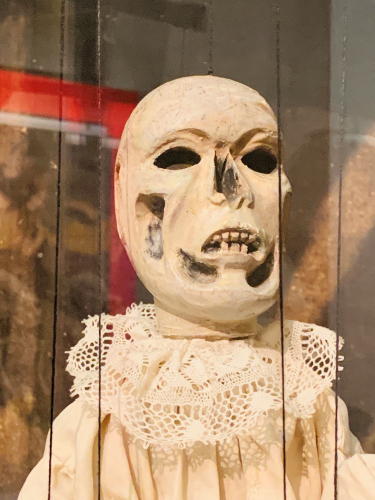
The puppeteer that first takes my attention is Mr KAREL NOVÁK (1862-1940), a travelling folk puppeteer, who performed plays, fairytales, political satire and comedies in Pilsen with his family. The Novák Family Theatre Collection of rare puppets, up to 150 years old are displayed, including the wonderful Faust Devils. The ‘Death Puppet’, carved by Mikoláš Sychrovský and the ‘Dr Faust- Dancing Devil’ puppet, circa 1840 carved by Josef Alessi (1807- 1856), were terrific marionettes. Another puppet that caught my eye was ‘The Long Eared Devil’ carved by Karel Novák, 1926: vivid in color, expression and form.


10. 11. & 12. Dr Faust Dancing Devil & Death Puppets – circa 1840’s – Museum Loutek Plzen – Photos A. Hawley 2018
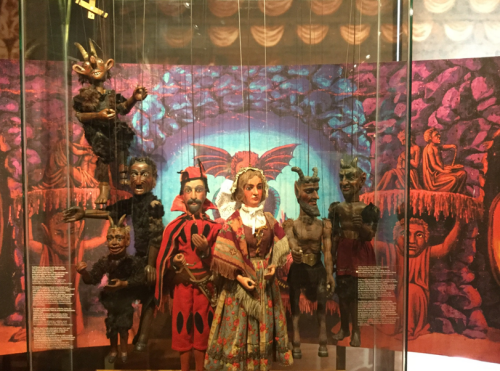
13. Dr Faust & Dancing Devil’s puppet collection- Museum Loutek Plzen – Photo A. Hawley 2018
Another influential puppeteer presented was Professor JOSEF SKUPA (1892- 1957) and the Summer Camp Puppet Theatre (LDFO) –(1914- 1935). Skupa was a set designer, illustrator, teacher, writer, director, technician and actor who dedicated four decades to puppet theatre: particularly cabaret style puppet shows for both adults and children. He had performed with Karel Novák and his legendary family of folk puppeteers. Skupa assisted in making Czech puppet theatre world famous, especially through the Spejbl and Hurvínek characters, recorded on gramophone in the 1920’s and which can still be heard today. Skupa was most noted for his unique vocal expression, sometimes voicing five or six characters in one play, from baritone to tenor and falsetto tones.


14. Josef Skupa with Spejbl & Hurvinek, 1929
15. The first Hurvinek carved by Gustav Nosek, 1927
16. Gustav Nosek, 1931
My first impression of Skupa’s work was the design of the Hurvínek puppet, circa 1940’s, a marvelous wooden puppet carved by GUSTAV NOSEK, (1887-1974). Skupa designed ‘Spejbl’ as a Dada inspired clown with a round face, big eyes, nose and ears, dressed in tailcoat and clogs. Hurvínek was a smaller version of the ‘Spejbl’ puppet, initially made unbeknownst to Skupa, but eventually paired with Spejbl as a father and son duo in 1930. The characters Mánička, a little girl and Žeryk, a dog also joined the production, designed by Skupa and Jiří Trnka. Spejbl was voiced by Skupa in the 1920’s and was initially partnered with the ‘Revolutionary Kašpárek’ puppet, (similar to the English ‘Punch’). Spejbl was originally carved by Gustav’s Grandfather, František NOSEK and his Uncle, Karel NOSEK.
Skupa married tradition and modern puppet theatre, with a flair for cabaret. These shows became a hit in Pilsen and symbolized the end of an empire in 1918, with the declaration of the sovereign state of Czechoslovakia. In 1920 he married JIŘINA SCHWARZOVÁ (1895-1970) who from 1928, operated Hurvínek’s strings for more than 30 years.Skupa was elected President of the Fourth Congress of International Puppetry Union– UNIMA in Ljubljana, 1933 and in 1948 became the first puppeteer to be awarded the title of National Artist.


17. Josef Skupa & Jirina Skupova, Spejbl & Hurvinek, 1947
18. Hurvinek
19. Josef Skupa with Spejbl & Hurvinek, 1948
Professor Skupa’s Pilsen Puppet Theatre (1930-1943) travelled abroad delivering 3,487 puppetry performances for both children and adults during this time, often commenting on the political and satirical. Skupa was arrested and jailed as a political prisoner in 1944 in Pilsen and Dresden, but escaped during an air raid. Once liberated, he worked in Pilsen radio and in 1945 opened the Spejbl and Hurvínek Theatre in Prague until his death in 1957. Miloš Kirschner (1927-1996) took on the roles of Spejbl and Hurvínek during the early 1950’s, whose successor then became Martin Klásek (b. 1957).
The most remarkable and memorable puppets I saw however, were those of JIŘÍ TRNKA (1912-1969). In particular, I absolutely loved Trnka’s ‘Self Portrait Puppet’, c.1930’s, with its elongated body, thinly carved arms and legs dangling with promise, an angular face, rounded melancholic eyes and fitted in a high necked, cross lapel costume with buttons. Its wooden face spoke to me, filled with gesture, expression and refined character.
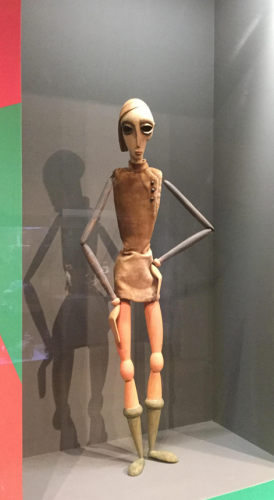

20. & 21. Jiri Trnka’s ‘Self Portrait Puppet’ 1930’s & ‘Macbeth’, ‘Samurai’ puppets 1930’s -Photos A. Hawley
Trnka was a puppet film Director, screenwriter, teacher, illustrator, painter and sculptor. He was very influenced by the seamstress skills of his mother and his grandmother, who handmade toys for him as a child. Born in Pilsen, he found his way into puppetry and theatre via Professor Josef Skupa, his art teacher at age eleven. Trnka laid the groundwork for Czech animation alongside stop motion masters Karel Zeman, Jan Švankmajer and Jiří Barta.
Trnka assisted the LDFO Theatre behind the scenes, making puppets, props and sets. He studied at the Academy of Applied Arts in Prague and then also became a teacher. Trnka headed the Summer Camp Theatre (LDFO) with the Kuncman Brothers until 1935. He then opened the Wooden Theatre, (the first professional Prague puppet theatre), showing only four productions until 1937. In 1945 Trnka co-founded the film studio Bratři v Triku, (Stunt Brothers), which led to the creation of 24 puppet films: 18 short and 6 feature length animated films. Some of my favorite Trnka films include ‘The Emperors Nightingale’ 1948, ‘The Hand’ 1965 and ‘Cybernetic Grandma’, 1962.
Trnka illustrated over 100 books, including a fairytale called ‘The Garden’, which he also wrote and then was latermade into a puppet film by Břetislav Pojar. He won the Hans Christian Andersen and the Méliès Awards, amongst other prizes. In 2012, the puppet museum restored Trnka’s diorama ‘The Beetles’ Wedding’, 1939 and put it on display. I would love to have seen that!
On the second floor of Muzeum Loutek Plzeň I then make my way up to a little Theatrette where you can try your hand at puppeteering, choosing from a wonderful range of wooden, folk style marionettes and expressive glove style puppets. I beeline for my favorite fairy tale characters Red Riding Hood and the Wolf, and am also treated to a lovely performance of a folk girl marionette by one of the friendly gallery attendants.

22. ‘Red Riding Hood, The Grandmother and the Wolf Puppets’ – Museum Loutek Plzen – Photo S. Iacono
The third floor of the museum presents a vast array of modern day theatre companies. In the 1950’s six puppet companies were active in Pilsen, including the traditional Novák Family Theatre, butstill performing today, arethe Špalíček Theatre, established in 1923 and the Puppet Theatre Club Boudě (In the Hut), established in 1928, which is amazing. In 1966 the Alfa Children’s Theatre started, which later became the Divaldo Alfa (Alfa Theatre) in 1992. In the 1970’s and 1980’s the theatre developed a vast repertoire of shows with different Dramaturges, Directors, Puppet Designers, staging and live music, including both classic and modern fairytales and world drama. Artistic Director Tomáš Dvořák, created shows for children and adults alike, combining different puppet techniques and acting styles. Of note is the ‘Three Musketeers’, 2006 a ‘glove puppet grotesque’, which has been performed in over 20 countries and won 27 awards.
From 1967 the Divaldo Alfahas assisted the presentation of the Skupa’s Pilsen Festival: a biennial presentation of professional puppet and alternative theatre. Between 1970-2012 the Divaldo Alfaundertook more than 100 international tours and have put on over 200 productions between 1966- 2012. Divadlo DRAK (DRAK Theatre, 1958-2001) is also of note, especially their successful production of Jiří Bártek’s ‘Enšpígl’, (1974/ 2000) with Puppet Design by František Vítek.


23. 24. & 25. DRAK Theatre – Jiri Bartek- Enspigl – Puppet Design Frantisek Vitek (1974/ 2000) – Photos S. Iacono & A. Hawley

26. DRAK Theatre – Jiri Bartek-‘ Enspigl’ – (1974/ 2000) – Puppet Design Frantisek Vitek. – Photo A. Hawley

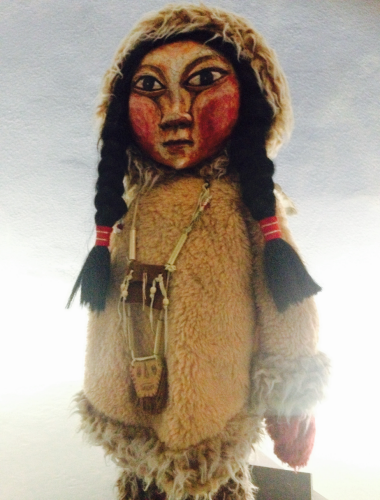

27. 28. & 29. Modern day puppet theatre displays Museum Loutek Plzen – Photos S. Iacono
Upon returning home to Australia I held my very first overseas experience close to my heart. It was everything I had dreamed of and worked towards for a number of years. To visit the home of many fantastic puppeteers and animation film makers I have admired was a true inspiration.
It was then with much dismay that two months post my return I was met with some terrible bad luck. A home burglary resulted in my camera device being stolen containing most of my overseas photos and consequent research into museum history. Most heartbreaking, were the loss of the bulk of my Muzeum Loutek Plzeň photos.
I was determined that the thief would not steal my memories or my story. Upon good advice from MIAF Director Malcolm Turner to draw those memories instead, I leave you with a sketch study and colored drawing of my favorite puppet, JiříTrnka’s ‘Self Portrait’, 1930. The only sure thing left to do now, is to save up and go back to the Czech Republic, to the inspired place of stop motion animation and the remarkable home of puppetry in Pilsen and beyond.


30. & 31. Drawings of Jiri Trnka ‘Self Portrait Puppet’, 1930 by Soncha Iacono, 2018
ARTIST STATEMENT
The Czech Republic is home to some incredible historical puppetry collections and stop motion animation and is a constant source of inspiration. My story and the artwork created for MIAF20][21, pays homage to those talented Puppeteers, Stop Motion Animators and Designers, who encouraged me to delve deep into its history. The gesture of the puppet, the magic of special effects and the mastery of weaving surreal storytelling style with folk tales is intrinsic to the expression of this type of animation. Through my sketches, photographs, drawings, writing and research explorations, I hope to bring their stories and characters back to life.
The following References pertain to the research I undertook writing the Essay about my travels trailing Puppetry & Stop Motion animation in the Czech Republic. I have included the Photographic References for both Museum Karla Zemana and Muzeum Loutek Plzeň, which I visited in 2018.
I have also included the References for the MIAF 20][21 Artwork acknowledging the Puppet Makers/ Designers and museum collection for each puppet character drawn. This includes my visit to the MLK Chrudim Puppetry Muzeum, which I visited on my second trip back to the Czech Republic in 2019, after writing my essay.
My return to this enchanting country also took me in search of the gravesides of Professor Josef Skupa and Jiří Trnka at the Pilsen Cemetery, where I paid my respects leaving drawings and flowers in their honour. Astonishingly, Professor Skupa’s headstone was a stone marionette Hurvínek!
… But that is another story… Stay tuned for the next chapter!
ESSAY REFERENCES
MUSEUM LOUTEK PLZEŇ
www.muzeumloutek.cz
- ‘The Story of Puppetry in Pilsen’ Booklet published 2012- Pavel Vašíček & MarkètaFormanová & the Archive of Museum of West Bohemiain Pilsen & associate archives.
- ‘Josef Skupa- Dnes a Denne Zazraky’ Booklet- published 2017- Pavel Vašíček & Tomáš Pfejfer & Archives of Pilsen- (‘Archiv Mesta Plzne’) & Muzeum Loutek Plzeň.
- ‘Josef Skupa- Miracles Today and Every Day– Skupa’s Legacy’: Information sheet Muzeum Loutek Plzeň: 2017
- ‘Josef Skupa: The Birth of a Modern Artist’: Pavel Jirásek– ‘Theatralia’– published 2015.
Digital Library of the Faculty of Arts, Masaryk University, Brno, Czech Republic.
https://digilib.phil.muni.cz
(Including Photograph Credits: ©Collections of Marie & Pavel Jirásek and ‘Loutkar’ Journal)
MUSEUM KARLA ZEMANA
www.MuseumKarlaZemana.cz
- Filmovy Klub: Karla Zemana:‘Filmovy Dobrodruh/ Film Adventurer: Karel Zeman’ & ‘Vynález Zkázy’: Documentary footage 2015 & Interviews 2012: Punk Film & Prokouk Productions
ESSAY PHOTOGRAPH CREDITS
- Color Photos: 1, 3, 6, 8, 9, 22, 23, 24, 27, 28, 29: © Soncha Iacono, 2018
- Color Photos: 7, 10, 11,12, 13, 20, 21, 25, 26, 30, 31: © Andrew Hawley, 2018
Historical Black & White Photos
(Sourced Online):
- Photo: 14: ‘Josef Skupa, Hurvínek & Spejbl’
Photo: 15: ‘The first Hurvínek carved by Gustav Nosek, (for Skupa), 1927’
Photo: 16: ‘Gustav Nosek, 1931 Pilsen’
All sourced from Article ‘Theatralia’– © Pavel Jirásek, 2015 & (‘Loutkar’ Journals 16/ 14/ 27).
- Photo 19: ‘Josef Skupa with Spejbl & Hurvínek, 1948’
Source: Article ‘Theatralia’- © Pavel Jirásek, 2015: (c) Collection Marie and Pavel Jirásek.
- Photo 17: ‘Josef & Jiřina Skupa & Hurvínek & Spejbl, 1947’
Source: (c) Collection Marie and Pavel Jirásek & Pavel Skupa
‘Francis Wright Weblog’: ‘Professor Josef Skupa’s Hurvínek and Spejbl: Puppets from Prague’: 2012
https://franciswright.wordpress.com/2012/08/08/hurvinek-and-spejbl-puppets-from-prague-4/
- Photo 18: ‘Hurvínek’
Source: ‘Divadlo Spejbl & Hurvínek Theatre’ Archive (1945-1957):
Article: ‘Magazín Aktuálně cz/ Kultura’: Zuzana Hronová, 2016.
Historical Black & White photos sourced from Museum Karla Zemana:
www.MuseumKarlaZemana.cz
(Re-photographed close-ups by Soncha Iacono, 2018):
- Photo 2: ‘Zeman Treasure of Bird Island’ (1952):
- Photo 4: ‘Zeman & Mr Pan Prokouk puppet’ (circa 1946-1959):
- Photo 5: ‘Mr Pan Prokouk puppet’ (circa 1946-1959):
REFERENCES FOR THE MIAF 20][21 ARTWORK: THE CZECH PUPPET CHARACTERS
Puppet Character Drawings and Photographs by Soncha Iacono 2018- 2020 based on puppet collections:
‘Muzeum Loutek Plzeň’ :(Muzeum of West Bohemia in Pilsen) www.muzeumloutek.cz
‘MLK- Muzeum Loutkářských Kultur Chrudim’ :(Chrudim Puppetry Muzeum) www.puppets.cz
1. ‘JIŘÍ PORTRAIT’– Drawing inspired by ‘Self Portrait’ Puppet by Jiří Trnka, 1930,
Muzeum Loutek Plzeň, www.muzeumloutek.cz
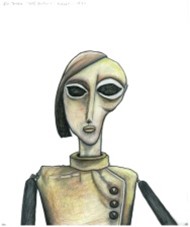

2. ’SAMURAI’- Drawing inspired by ‘Samurai’ Puppet by Jiří Trnka, 1930, Muzeum Loutek Plzeň, www.muzeumloutek.cz


3. ‘PICKLES’– Drawing inspired by ‘Enspigl- The Prankster’ by Jiří Bártek- 2000/1974- Original Puppet Design- Frantisek Vitek, DRAK Theatre (Divaldo DRAK), Muzeum Loutek Plzeň, www.muzeumloutek.cz

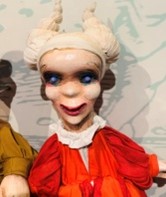
4. ‘PUPPET BOY’– Drawing inspired by ‘Spejbl’ Puppet by Gustav Nosek, 1930’s
Muzeum LoutekPlzeň, www.muzeumloutek.cz


5. ‘PIANIST 2- SIDE VIEW’– Drawing inspired by ‘Pianista’ Puppet by Jiří Trnka, 1930’s
MLK- Muzeum Loutkářských Kultur Chrudim, www.puppets.cz


6. ‘PIANIST- FRONT VIEW’– Drawing inspired by ‘Pianista’ Puppet by Jiří Trnka, 1930’s
MLK- Muzeum Loutkářských Kultur Chrudim, www.puppets.cz


7. ‘WIZARD- TAKE 2’- Drawing inspired by ‘Witch’ Puppet by Jan Dolenský, circa 1918
MLK- Muzeum Loutkářských Kultur Chrudim, www.puppets.cz


8. ‘CLOWN 2’- Drawing inspired by ‘Dupak’ Puppet by Josef Soukup, 1916,
(Vaudeville marionette carved for Tomas Dubsky)
MLK- Muzeum Loutkářských Kultur Chrudim, www.puppets.cz
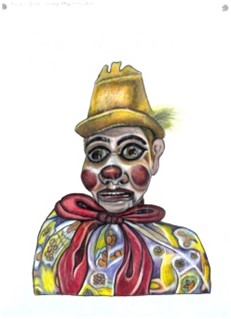

9. ‘BLUE DEVIL- TAKE 2’- Drawing inspired by ‘Devil’ puppet by Anton Sucharde,
mid-late 19th Century
MLK- Muzeum Loutkářských Kultur Chrudim, www.puppets.cz
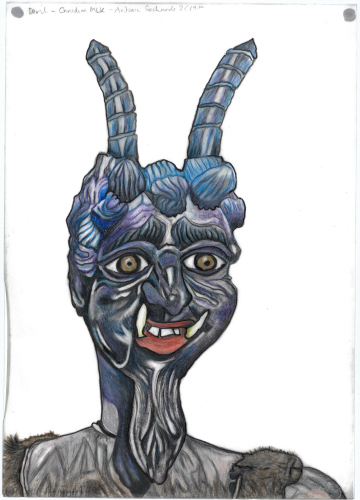
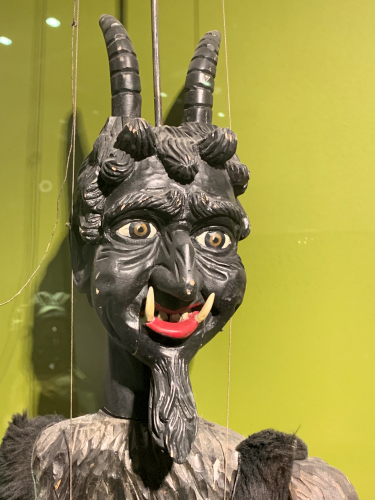
10. ‘DANCING DEVIL’- Drawing inspired by ‘Faust Devil’ Puppet- by Alessi- 1840
Muzeum Loutek Plzeň, www.muzeumloutek.cz
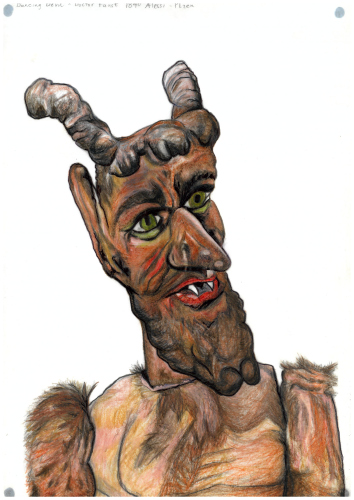
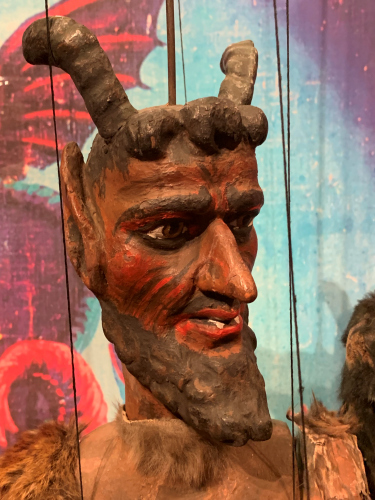
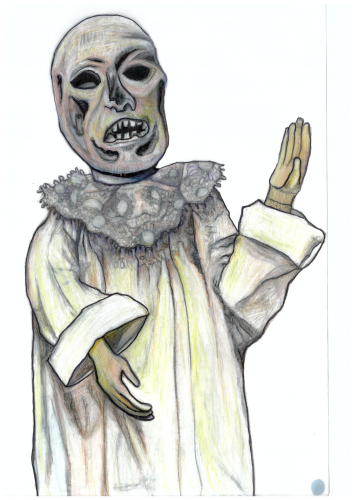
11. ‘GHOST GOWN’ -Drawing inspired by ‘Ghost Death’ Puppet by Mikoláš Sychrovsky,
Late 19th Century
Muzeum Loutek Plzeň, www.muzeumloutek.cz
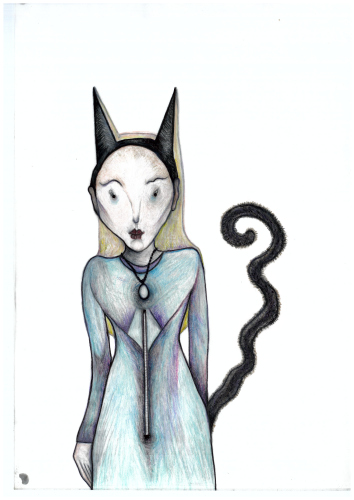
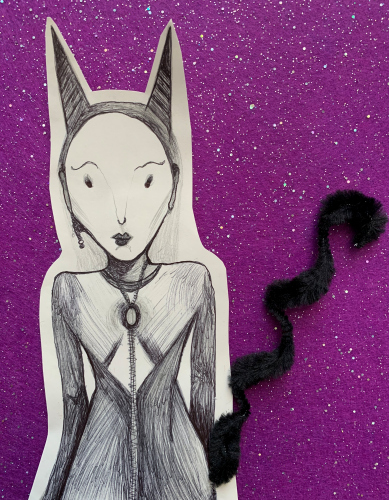
12. ‘DEVIL CAT GIRL’- Drawing & Original Design by Soncha Iacono as a Ode & Hommage to Jiří Trnka, 2019- 2021
‘MIAF 2020 REANIMATED’ -OPENING NIGHT SPEECH-Thurs 13th May, 2021 ACMI CINEMA!
THE NEXT CHAPTER: The Czech Puppetry Trail Continues… By Soncha Iacono
I pay my respects to the Wurundjeri and Boon Wurrung of the Kulin nation of Melbourne on the place we meet tonight along the Birrarung Marr. I also pay my respects to the palawa kani and muwinina people of lutruwita, Hobart, Tasmania, the place where I live, work and share. I acknowledge the land, waterways, mountains and animals and all Elders and Youth, past present and emerging.
A big Thank you to Malcolm, Annie, Michael, the MIAF Team and ACMI for giving me the unique opportunity to share my experiences with you tonight.
Malcolm Turner has been an inspiration and a mentor, guiding me along the road to discovering puppet animation and stop motion over the last 20 years. Malcolm’s dedication, knowledge and enthusiasm for the Australian and International animation community is beyond measure. I’ve always looked forward to his engaging introductions to the MIAF programs every year. These always made me feel connected to the animators and where they came from. I loved reading all his MIAF catalogue essays, about his travel stories hunting down animations in places far and wide, and I always felt teleported as I incubated within the MIAF screenings.
This connection inspired the writing of my first person essay on the MIAF website, and the completion of over a dozen drawings of puppets and the Melbourne skyline, which are part of the MIAF designs for 2020 and 2021. Whilst working as a VSO with ACMI between 2010 and 2015, Malcolm would encourage us to attend lots of MIAF sessions, which I did. As a gift of gratitude I would draw Malcolm one of my characters. I believe he now has quite a collection of these drawings! The Cat Girl drawing featured in MIAF 2021 represents her story.
The three puppetry museums I visited in the Czech Republic were: Museum Loutek Pilsen & Karel Zeman Museum in 2018 and the MLK Chrudim Puppetry Museum in 2019. The puppetry collections housed within have been my resource of inspiration for the 12 MIAF Puppet Drawings in this year’s artwork for the festival, which you can see on the MIAF & ACMI websites and social media banners.
I visited the Czech Republic in 2018 on my very first ever European trip. I spent hours within Loutek Plzen andthe Karel Zeman where I was completely immersed and inspired, peering into the intricate world of puppetry and stop motion. I read, sketched, watched, photographed and wrote about the brilliant worlds of puppet pioneers from the early 19th century to the 20th century & beyond.
The wonderful Loutek Plzeň sits opposite the grand Cathedral of Bartholomew & an impressive town square filled with market stalls, spruiking hot crepes, coffee and gingerbread candy, along with the tinkering sounds of a delightful horse carousel.
The museum displays the Novák Family Theatre Collection of rare puppets, up to 150 years old, including the wonderful, carved Faust Devils. The ‘Death Puppet’ by Mikoláš Sychrovský and the ‘Dr Faust- Dancing Devil’ by Josef Alessi were terrific marionettes. These puppets inspired the Dancing Devil and Ghost Gown drawings which are part of my MIAF artworks.
Professor JOSEF SKUPA wasanother influential puppeteer that inspired me in the museum. Skupa was a set designer, illustrator, teacher, writer, director, technician and actor who dedicated four decades to puppet & cabaret style puppet theatre. Skupa assisted in making Czech puppet theatre world famous, particularly through his Spejbl and Hurvínek characters. Skupa designed ‘Spejbl’ as a Dada inspired clown with a round face, big eyes, nose and ears, dressed in tailcoat and clogs, also carved by Gustav Nosek. This became the inspiration for my MIAF drawing Skupa, aka Puppet Boy.
JIRI Trnka also featured. Hewas a puppet film Director, screenwriter, teacher, illustrator, painter and sculptor. He was very influenced by the seamstress skills of his Mother and Grandmother, who handmade toys for him as a child. He found his way into puppetry and theatre via Skupa, his art teacher. Trnka laid the groundwork for Czech animation alongside stop motion masters Karel Zeman, Jan Švankmajer and Jiří Barta.
But now, a special sneak peek of my Next Chapter continues tonight along My Puppetry Trail in the Czech Republic….
A stroke of luck gave me the opportunity to revisit Czech Republic in 2019, a year and a half after my photographic research photos were unfortunately stolen and just before the Covid Pandemic hit worldwide; it seems that fate had further plans for me!
I was determined that the thief would not steal my memories or my story. Upon good advice from Malcolm Turner to draw those memories instead, the Miaf Puppet Character Artworks resulted!
Not only was I able to revisit Loutek Plzen and the Karel Zeman, but I was able to explore another fascinating puppetry collection: the MLK Chrudim Puppetry Museum. I found myself once again boarding a train out of Prague into the very heart of Bohemia, to the enchanting town of Chrudim.
MLK and the Czech Ministry of Culture present a captivating exhibition housing traditional, contemporary, oriental and classical puppetry from around the world in a brilliant permanent show called ‘The Magical World of Puppets’.
As you enter through the stone arched doorway and wooden door, you then come into a maze like collection of rooms, filled with tiny staircases and various corridors. As you pop around every corner you are greeted with an array of puppets divided into each era, within a labyrinth which opens up like a concertina booklet.
Of all the puppets within the MLK collection, one of course literally took my breath away; the gesture of his hand, the expression of his face, the melancholy in his eyes and its sheer musicality! The ‘Pianista’ puppet by none other than Jiří Trnka!
Other puppets which caught my eye were the ‘Dupak’ Clown, a Vaudeville marionette by Josef Soukup, the ‘Witch’ by Jan Dolenský, who stands in his pointed hat, poised behind his spectacles, gazing through you and the carnivalesque ‘Faustian Devils’: particularly the puppet by Anton Sucharde with its spookily carved face. Their wooden hands, suspended strings, detailed costumes amongst velvet curtains were indeed a spectacle! Each puppet could tell countless stories, as you imagine the Puppeteers, their voices and movements bringing them to life.
These puppets inspired my MIAF drawings The Clown, Blue Devil and The Wizard.
It is easy to see why museums such as these harbour cultural significance, through cataloguing and presenting such exquisite puppetry collections. In 2016, Czech and Slovak puppetry were inscribed on UNESCO’s representative list of the Intangible Cultural Heritage of Humanity.
It is with this sentiment in mind that I chose to also pay my respects at the gravesides of Professor Josef Skupa and Jiří Trnka, when back in Pilsen. This gave me the opportunity to offer my gratitude to the years of inspiration these puppet makers & designers have given me.
The walk to the cemetery from the centre of Pilsen took two hours, trailing the streets, along forests and industrial areas. Finding Jiri Trnka’s grave and discovering Skupa’s headstone to be none other than the stone marionette of Hurvínek, was incredible! I sat and drew a puppet and wrote some words in their honour, offering it with a small posy of flowers. It was a very special moment.
Most of all, this experience adds yet another chapter to my Puppetry Trail in the Czech Republic, bringing to fruition the story behind my puppet drawings and artworks for MIAF 2020 Reanimated and MIAF 2021 set for July this year, as a dedication to the extraordinary puppet makers, bringing them to life once more.
I hope to continue my exploration and research into Czech Puppetry, pausing until I can travel again to the Czech Republic, when hopefully we can once more take to the skies post a pandemic laden world. Who knows when this will be possible, but it is certainly on the cards, where more puppetry museums await for me in the heart of Bohemia…
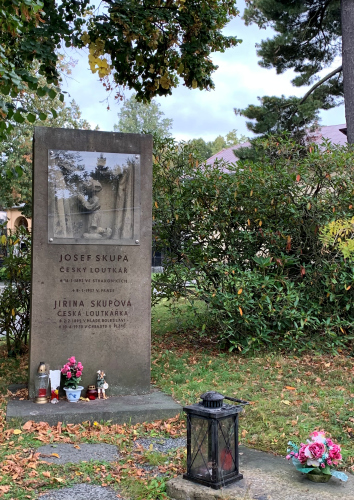
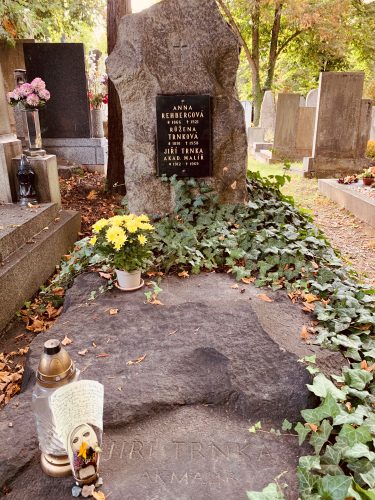
Professor Josef Skupa’s & Jiří Trnka’s Graveside Pilsen Cemetary Czech Republic 2019-
Photo S. Iacono